

We want to increase the number of inquiries we receive through our own website.
An eternal challenge faced by every business owner and marketing professional.
Like many others, Mr. Takanori Nishikawa, who is in charge of marketing at Bizmates Inc., was also looking to increase the number of member registrations coming from the company’s service website.

(Ms. Nishikawa, Marketing Manager at Bizmates Inc.)
Mr. Nishikawa is in charge of marketing for Bizmates, the business-focused online English conversation service that also lends its name to the company.

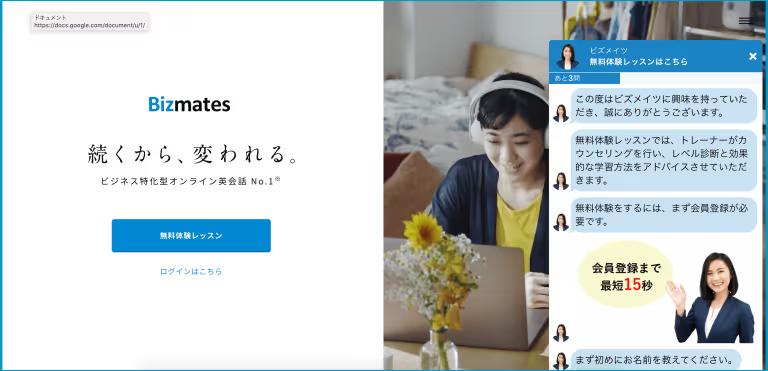
(Top image of the “Bizmates” website)
As part of our efforts to increase the number of free members, we implemented various measures to optimize the input form, but the key issue—its high abandonment rate—has been slow to improve.
The new marketing initiative we introduced there was the implementation of the chatbot service “BOTCHAN.”
(The chatbot service “BOTCHAN” installed at the bottom right of the site)
As a result, the CVR from smartphones (i.e., membership registration rate) improved by 133% compared to the previous month.
In this interview, we asked Mr. Nishikawa about various topics, including the initiatives tried before introducing BOTCHAN, the results achieved through its implementation, and, finally, how they are addressing newly emerging marketing challenges.
I’m Takayanagi, the Customer Success (CS) team leader at wevnal Inc., the company that provides BOTCHAN, and I will be serving as today’s interviewer.

(Takayanagi, CS Team Leader at wevnal)
Does BOTCHAN really deliver results?

Interviewer Takayanagi (hereafter, ━━): Before implementing BOTCHAN to improve your site’s CVR, what kind of initiatives were you undertaking?
Nishikawa (hereafter, “Nishikawa”): One thing we did was to “keep the number of input fields to an absolute minimum.” Before we implemented BOTCHAN, we were using a standard registration form, but we kept it very simple, with just “Name,” “Email address,” and “Password.”
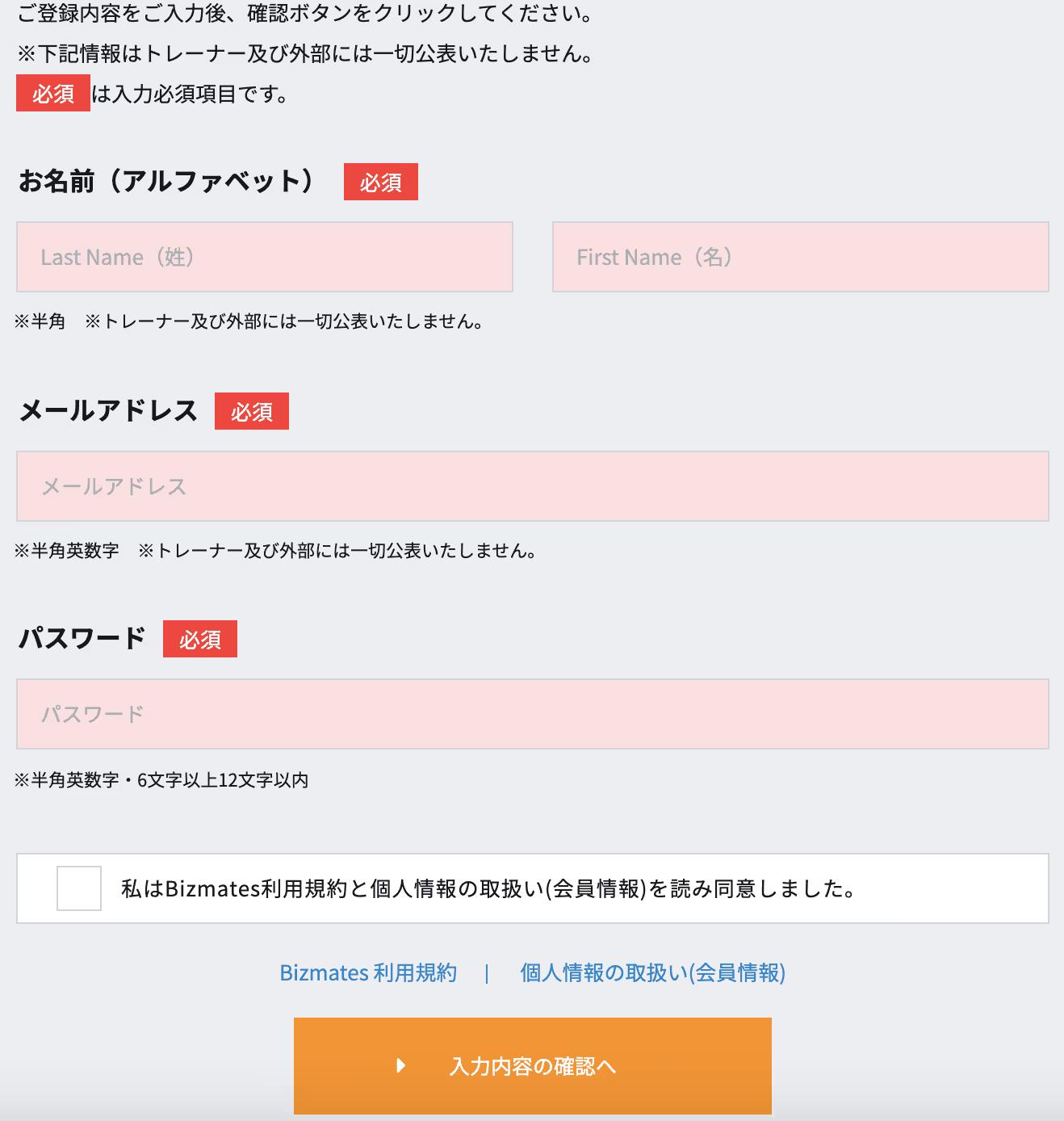
(Registration form previously used on the Bizmates website)
━━ The more items there are, the more likely customers are to drop out partway through, so it is important to keep the number of items to a minimum.
Nishikawa: We had also implemented an input-assistance tool in our standard registration form. It’s a tool that tells customers things like, “You’re only a few questions away from finishing,” or, if they enter something incorrectly, for example, “This field requires half-width characters.”
We tried various measures like that, but the abandonment rate on the form just wouldn’t come down. Around that time, we received a proposal for BOTCHAN from wevnal, a company we had already been working with.
━━ When you actually decided to implement BOTCHAN, did you have any concerns?
Nishikawa: The key question is, “Will it really be effective?” The appeal of chatbots, fundamentally, is that even when a form has many input fields, the conversational format makes it easier for users to get through.
However, in our case, we had already pared down the number of fields to the bare minimum, so I was unsure whether introducing a chatbot would actually change the numbers. That point was a concern for me.

━━ Given those concerns, what was the decisive factor that ultimately led you to implement BOTCHAN?
Nishikawa: There are two points. The first is that we were shown successful case studies from other companies in the same industry. The second was a comment from Mr. Takayanagi, who is in charge of our company as a CS representative, pointing out that “Isn’t your current input form causing a mismatch in understanding between your company and your customers?”
━━ When I looked at your company’s website as an ordinary user, I felt a bit of discomfort that, although the wording “Free Trial Lesson” appears on the top page, clicking that button suddenly takes you to a “Free Member Registration” screen.
I imagine some customers may have felt, “I clicked the button because I wanted a free lesson, so why did it suddenly turn into a member registration screen?”

Nishikawa: The flow of our service is as follows: first, users register for a free membership, next they take a free trial lesson, and finally they sign up for a paid membership. So, in order to take a free lesson, users were required to complete the free membership registration first.
━━ I realized how important it is to ensure that customers also understand the steps involved. So, on the initial BOTCHAN screen that appears after clicking the “Free Trial Lesson” button, we decided to clearly state two points: first, that “You need to register as a free member first,” and second, that “This registration is simple and can be completed quickly.”
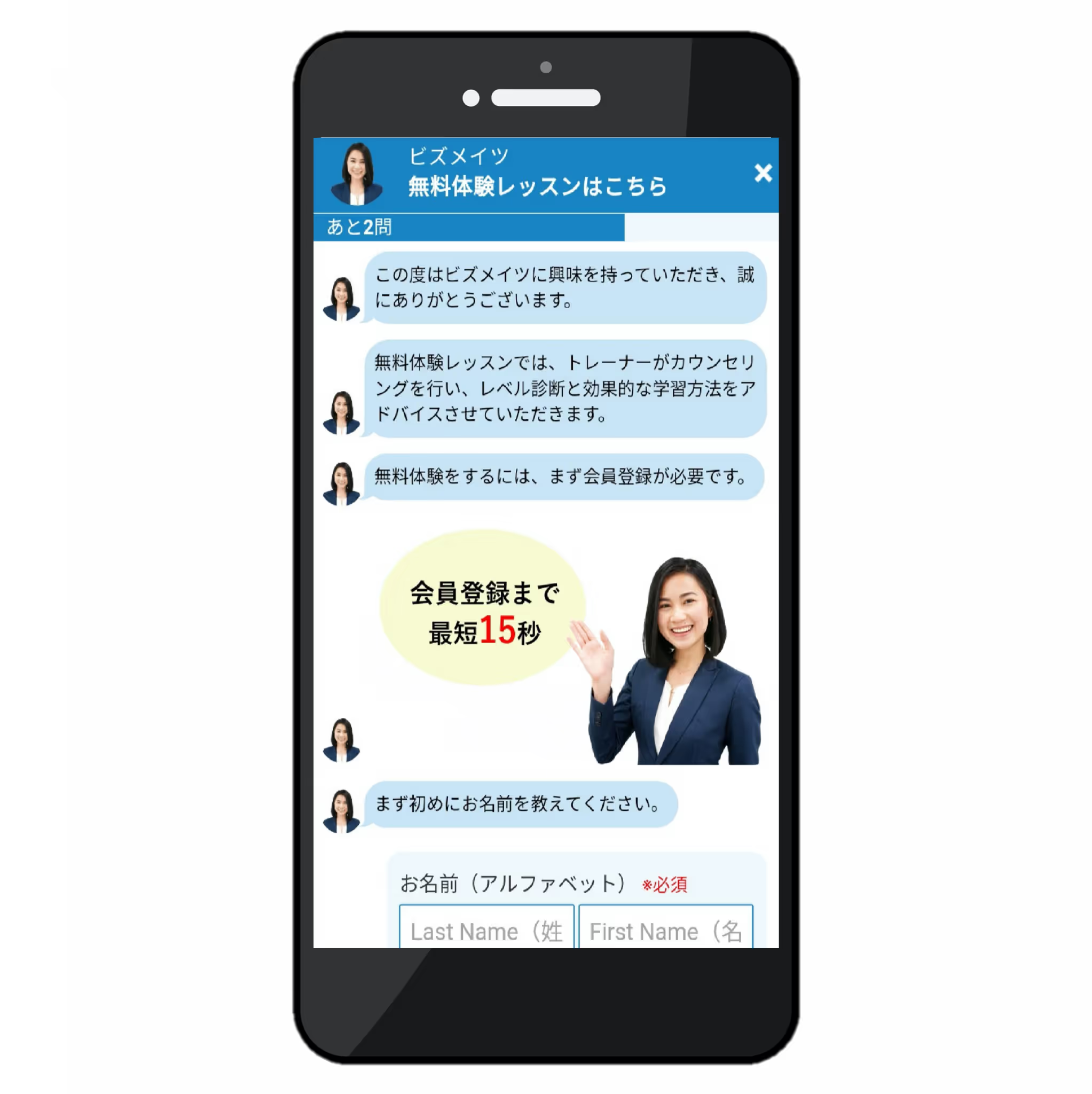
(First, clearly state the need to register for a free membership to avoid any misunderstanding with the customer.)
Nishikawa: When I received that kind of proposal from Mr. Takayanagi, I felt, “I’d really like to try that.” That became the second reason we decided to introduce BOTCHAN.
The “rapid PDCA” behind the numerical improvements
━━ After you actually implemented it, did you see any change in your CVR figures?
Nishikawa: Yes, we did see that. When we compared the month we introduced BOTCHAN with the previous month, the overall CVR improved by 117%. In particular, the improvement in CVR from smartphones was 133%, which is a significant increase. Since about 60% of Bizmates’ traffic comes from smartphones, this improvement has a major impact.

━━ We packed this with the full range of expertise our CS team has accumulated—covering overall design, the creatives such as inserted images, and the scenario—so I was confident it would definitely deliver results. Even so, I am very pleased that we were able to see the impact so quickly in practice.
Nishikawa: Another advantage is that, unlike making changes to the site itself, with BOTCHAN we can quickly run PDCA cycles for improvements.
For example, in our case, if we want to modify the site, the marketing department where I work first has to submit a proposal to the creative team, and then, when it comes time to implement, we need to put in a request to the engineers, so it has to go through multiple steps.
As a result, even if we just want to change a single line of copy on the site, it can end up taking about a week.
━━ It’s understandable that it’s not easy to make casual revisions when there are so many stakeholders involved...
Nishikawa: In the case of BOTCHAN, everything can move forward just through communication between your company and me, so if, for example, we decide we definitely want to try the improvements you propose, we can start testing them right on the spot.
BOTCHAN had been delivering a certain level of results from the beginning, but I believe the reason we were able to improve the numbers even further is also due to the impact of these kinds of detailed optimizations.
━━ Yes, that’s right. In fact, in the initial phase after implementation, we faced an issue where the CVR on PCs was slightly lower compared to smartphones. To address this, we increased the size of the bot and the text to improve visibility.
As a result, we were able to raise the CVR from PCs as well, which was a positive outcome.
Chase two hares and catch them both.

━━ Now that you have implemented ━━BOTCHAN and improved your CVR, are there any marketing challenges you would like to tackle next, Mr. Nishikawa?
Nishikawa: What I’ve been thinking about lately is “improving the conversion rate from free members to paid members.” Of course, we still want to keep increasing the number of free members as well. I’m very pleased that our CVR has improved and that the number of free members has grown.
On the other hand, you could say that people who previously would not have registered—customers who are not necessarily highly engaged—may now be signing up as free members.
━━ Drawing the line on how far we should lower the hurdle for registration is a difficult issue...
Nishikawa: What we are aiming for is to increase the number of free members while maintaining the conversion rate to paid memberships.
To that end, for example, when users sign up as free members on BOTCHAN, we would really appreciate your advice on what kind of information we should provide and what kind of communication we should have with them so that it becomes easier for them to move on to free lessons and paid membership registration afterward.
━━ Of course. I would be pleased to continue supporting your company, and I look forward to working with you going forward.
...
If you are considering implementing BOTCHAN and would like concrete advice tailored to your company’s potential use cases and current situation, please feel free to contact us.
Our consultants will be pleased to assist you.