
![[D2C HACK DAY Event Report] ECH President Iseki on Stage! Why Did “KAMIKA” Become a Hit in a Mature D2C Market?](https://cdn.sanity.io/images/cq2mc10e/production/fd2ce24fc04579d4f0178e35fbaf24a252a1e11e-1676x796.jpg)
On March 28, 2023, the online eventD2C HACK DAYwas held to great acclaim.
For those who missed the event or would like to review the content again, we have compiled this report.
In this first installment, we present a talk session between Mr. Iseki, President and CEO of ECH Inc., and Isayama, CEO of wevnal Inc.
Speaker Introduction

Takahiro Iseki
ECH Inc. / President & CEO
Originally from Kochi Prefecture. After joining Daiwa Corporate Investment, a Daiwa Securities–affiliated venture capital firm, as a new graduate and working there for five years, he served as Director and CFO of United (formerly Net Age) and led its listing on the Tokyo Stock Exchange Mothers market, then founded ECH in 2006. He has also served as an outside director at several companies, including J Frontier, Temairaz, Fujisan Magazine Service, IID, and Niku no Hanamasa.

Hirofumi Isoyama
wevnal Inc. / President & CEO
Joined a major internet company as a new graduate in 2008. Founded wevnal Inc. in April 2011 and launched the BX platform “BOTCHAN.” After raising a total of 1.6 billion yen in funding, the company now supports clients in increasing their sales through the BX (Brand Experience) platform BOTCHAN, which prioritizes users’ brand experience across the entire journey from acquisition and purchase to retention and cancellation.
The brand “KAMIKA,” which drove significant growth for ECH Inc.
wevnal Hirofumi Isoyama (hereafter, Isoyama):
Today I’ll be speaking with President Iseki of ECH Inc.
Thank you very much for joining us.
Mr. Iseki, could you please start by introducing yourself?
ECH, Mr. Takahiro Iseki (hereafter, Mr. Iseki):
Thank you for having me. Let me briefly introduce myself.
After joining a venture capital firm straight out of university and working there for five years, I changed jobs and then founded my current company, ECH Inc., in 2006. ECH Inc. operates several hair care brands, including the cream shampoo KAMIKA, the hair-care supplement Black Supplement, and the treatment Tricore, among others. In 2021, we also entered the cosmetics field. We have been running our mail-order business since 2007, and as the pace of change in recent years has been faster than ever, I hope we can also discuss that area with you, Mr. Isoyama.
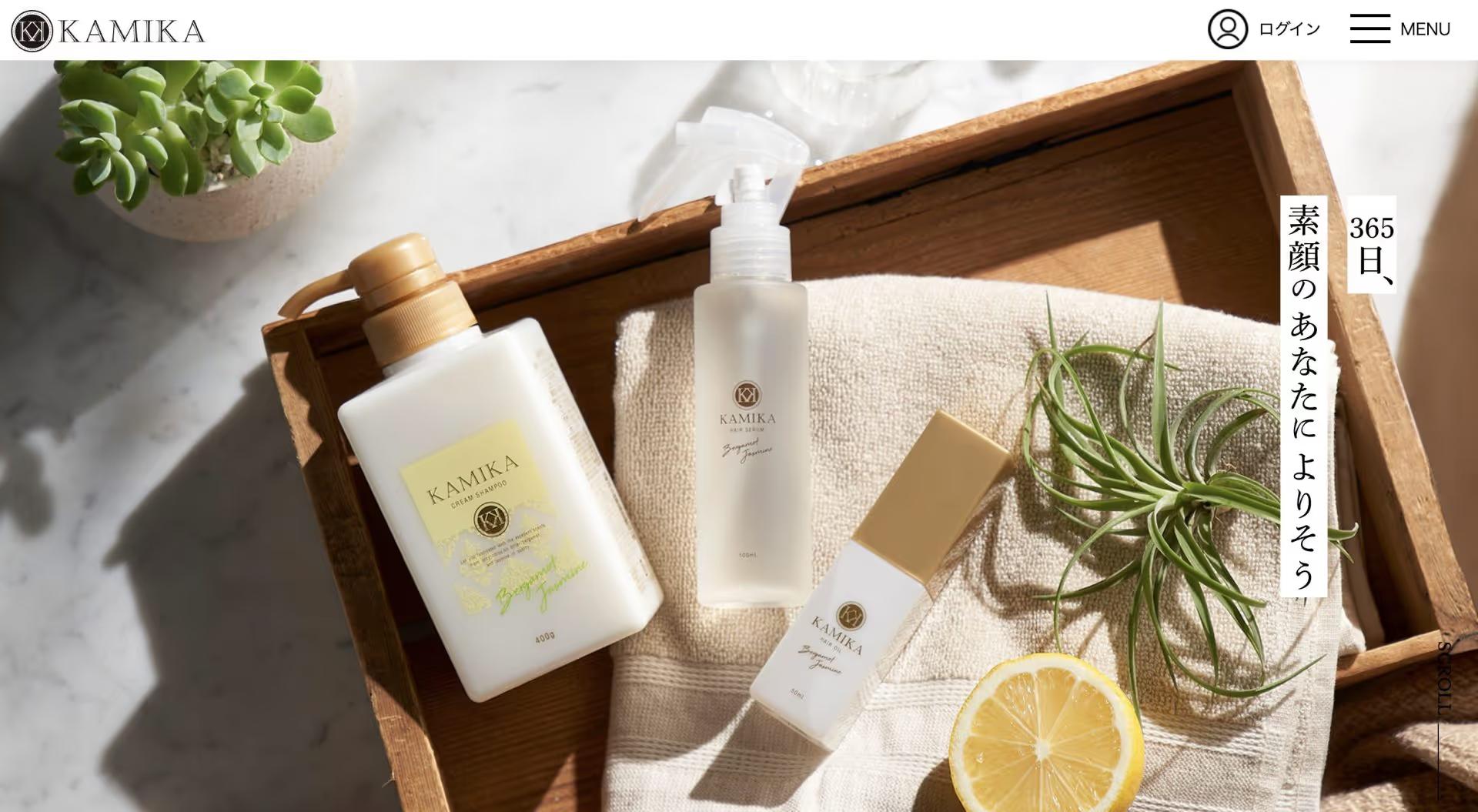
“KAMIKA” Service Website
Isoyama:
Yes, please do. Back in 2007, terms like D2C were not yet common, so business models like this were not mainstream either. ECH entered e-commerce at a very early stage, and I would like to discuss that aspect as well today.
To begin with, I would like to ask you about the initiatives ECH has been undertaking and how you have grown the performance of “KAMIKA.” In the midst of various trends and fads, please tell us how you have built up the brand.
Iseki:
This may sound blunt, but it is extremely difficult to reliably reproduce a hit product, and I believe “KAMIKA” became popular because a variety of factors came together, leading many customers to purchase it during a certain period. In the very beginning, we were selling custom-made supplements, but sales were not strong at the time. When we repositioned them as supplements that seemed good for skin and hair care in order to clear inventory, that became the trigger for the company’s growth.
After that, as our customer base grew, we decided to develop a new product for customers who were particularly concerned about hair issues, and that is how we developed “KAMIKA.”
Our initial target was women in their 40s to 60s, and over the following year and a half, we also developed a shampoo.
Isoyama:
I felt that advancing the project over a year and a half required considerable time and effort, but was there a point when you felt it was really paying off?
Iseki:
I honestly had no sense at all of whether it would sell or not. That’s really the difficult part when you’re launching something from scratch, isn’t it? In that respect, because we were already running a supplements business, we had accumulated a great deal of know-how from a hair care perspective. Compared with other fields, I think that made it relatively easier to get this off the ground.
Isoyama:
As a company, you already had a certain amount of in‑house know-how, and you carried over what worked well in the PDCA cycles of customer support and marketing, then expanded on that to create a new product. In other words, by moving forward while leveraging the strengths of the organization, a new product was born.
I believe you have launched various other products besides the KAMIKA brand. Are there any particular points you pay attention to when you are launching a new product?
Iseki:
Since I’m not someone who has continuously produced hit products myself, it’s hard for me to say “this is the right answer,” but I do believe that, once you’ve had one success, developing a new product again within the same organization becomes significantly more difficult. Marketing tends to focus its efforts on things that are easier for new customer acquisition, and CRM also tends to concentrate on areas where you can include a lot of inserts and get strong leverage.
This is my personal theory, but when you launch a new product, I think it’s better to spin it out into a separate company. Alternatively, you should at least create a separate organization that handles planning, marketing, and CRM.
To be honest, I overdid this part myself.
Looking back, I think I went too far in subdividing functions, even down to CS and fulfillment. In this area, the more products you have, the more know-how you accumulate, and in hindsight I regret that it probably would have been more efficient to keep them together. (laughs)
When it comes to building an organization that can generate revenue and grow from 1 billion to 2 billion, then 3 billion yen and beyond, I believe that staffing and team structure are extremely important, with that growth trajectory in mind.
What are the factors for success?
Isoyama:
Thank you very much. There are synergies that come from having multiple brands, and there are also ways to pursue a single-brand strategy.
I’d like to move on to the next discussion topic now, and we have a timely question from a viewer about the “factors behind your success.” I imagine there are many different factors, but I would appreciate it if you could tell us about the trigger or turning point that led to your best-selling or most successful outcome.
Mr. Iseki:
Up until around 2018, we were focused on selling supplements, but due to revisions to the Act against Unjustifiable Premiums and Misleading Representations and other factors, we shifted our sales strategy to shampoos. We believe a key success factor was that we invested heavily in advertising at the moment when women in their 50s and 60s started using smartphones and began purchasing products online, and we concentrated on acquiring new members. That said, I suspect it would be difficult today to advertise at such low cost as we did back then...
In the past, there was a period when we were acquiring more than 20,000 new members per month at a CPA of around 8,000 yen. However, the D2C business model is inherently tough on cash flow because of the need to secure inventory and make upfront investments in advertising, so I feel that external support is essential.
This is especially true for venture companies, where support from banks, advertising agencies, logistics companies, and support firms like wevnal is indispensable.
Even in the current environment, we are in an era where we must constantly adapt to change. It is important not only to rely on traditional business models, but also to quickly grasp new technologies and trends and incorporate them into the business. As we can expect even more diversified business models to emerge in the future, I believe it is crucial to always keep our antennae up.
Isoyama:
I see, that is indeed an important point.
Since inventory management and the adjustment of advertising expenses are critical factors that affect both brand building and accelerating sales, I am once again reminded how difficult it is to manage them. Depending on the timing, there is a desire to ramp up marketing, while on the other hand issues such as delays in inventory adjustments can arise. I believe that resolving these issues requires an appropriate sense of balance, but how do you manage and control this overall?
Iseki:
That aspect changes on a daily basis. For example, if it’s just a single product, inventory management is relatively straightforward, but with cosmetics there are multiple items and gifts tailored to each product, which causes confusion in the warehouse. The inserts we include also differ by customer, and we are adjusting more than ten variations while running repeated A/B tests. It would be nice if we had a single product that could generate 10 billion yen in sales. (laughs)
Isoyama:
Yes, it really is something to be jealous of. (laughs)
I’d like to dig a bit deeper into the “factors behind your success.”
We’ve been working with ECH since around 2017, and compared with that time, I believe there have been changes in acquisition and marketing conditions, as well as in the IT literacy of your customer base.
I’d like to hear a bit more about how you have aligned with those changes and steered the business toward success.
Mr. Iseki:
Understood.
I believe that trust and communication with our partner companies are very important, and I also feel that the level of the solutions themselves is steadily improving.
The service from wevnal that we are currently using,“BOTCHAN Keeper”, is a service that, by creating scenarios, uses chat to handle customers who are in the continuation/cancellation phase of their subscription.
Originally, we were using the phone, which meant that the tone and nuance of communication varied by operator, and we saw this inconsistency as an issue.
By using chat here, we have been able to visualize the patterns that lead customers to continue, and we are running PDCA cycles and conducting A/B tests. We promote subscription continuation through this service for several thousand cases per month.
In this way, it is important to leverage technology and services to conduct business more efficiently.
Incidentally, I do not think that phone calls will disappear, but we must address the question of whether we can provide a service that feels good for customers.
Naturally, on Monday mornings, for example, it is hard to get through by phone to any company, and if management does not keep innovating, they will be left behind by the times.
The most frightening thing is becoming fixated on a single success pattern.
In fact, when “KAMIKA” sold well, I have to admit that I personally let my guard down. Once people fall into a success pattern, they tend to regard it as absolute.
So, of course, it is fine while that pattern is working well, but management must constantly face new information and continue to refine their own services and products. If you cling to a success pattern, it will become obsolete, so you must always be looking for new ideas and areas for improvement.
Isoyama:
It is true that with the rise of social media and new technologies, we can sense that business and consumer behavior are changing rapidly. In addition, the spread of success stories seems to be accelerating the pace at which markets become more uniform.
Iseki:
Exactly. I also feel the level of difficulty is rising year by year.
It’s tough, but in the end entrepreneurs are destined to take that on.
Maintaining the status quo is the same as decline.
Even though it’s a challenging situation, if we can keep taking action while enjoying it and grow ourselves in the process, I believe the business will expand as well.
Isoyama:
I see. Thank you very much for sharing such valuable insights.
Let’s continue to push each other to improve for the development of our industry.
I look forward to working with you going forward.
If you would like to confirm whether BOTCHAN can be implemented in your company, or if you would like advice tailored to your situation, please feel free to contact us with your questions or inquiries. A specialist consultant will respond to you.