
![[D2C HACK DAY Event Report] TeN × BULK HOMME Talk Session: “What CRM Initiatives Build Customer Trust? A Marketing Discussion on the Behind-the-Scenes Brand Support by BULK HOMME and TeN”](https://cdn.sanity.io/images/cq2mc10e/production/088a3643fb61a478cb9faba2809d5c116bf5c626-1024x538.webp)
On March 28, 2023, the online event D2C HACK DAY was held to great acclaim.
For those who missed the event or would like to review the content again, we have compiled this report.
In Session 4, we held a session titled “What CRM initiatives build customer trust? A marketing discussion with BULK HOMME and TeN on the behind-the-scenes of brand support.”
Here is our report on that session.
Speaker Introduction

Hideki Ikeda
TeN Inc. / EC Division Manager
After graduating from Meiji University, I joined Waqoo Inc. as a member of its first cohort of new graduates. After working in sales promotion, focusing on new customer acquisition for the company’s health foods and cosmetics, I led the overseas expansion of these products into Taiwan as the business owner. Having grown the business to annual sales in the hundreds of millions of yen, I then joined TeN Inc. Since joining, I have been participating as a project manager in launching in-house e-commerce brands in categories such as food, cosmetics, and gadgets, overseeing everything from planning and launch through to growth.
Mr. Kanta Morimoto
BULK HOMME Co., Ltd.
Joined BULK HOMME in 2022 as a member of the first cohort of new graduates. After being assigned to the LTV Division, I have been responsible for overall retention marketing for subscription customers. Most recently, I have focused on initiatives to improve retention rates for inbound and chatbot channels, building and operating a multi-company structure for outbound centers, and enhancing the “MY CHOICE” service, which allows customers to freely change the products delivered in their subscription plan.
Moderator: Akihiro Morimoto
wevnal Inc. / Executive Officer, CSO
Theme 1: Channels focused on CRM initiatives
wevnal Akihiro Morimoto (hereafter, A.Morimoto):
Today, I will be speaking on two themes.
The first theme is about “channels we are focusing on for CRM initiatives.”
First, please take a look at this summary of the CRM initiatives that TeN and BULK HOMME are actually implementing, and which channels each company is currently prioritizing.
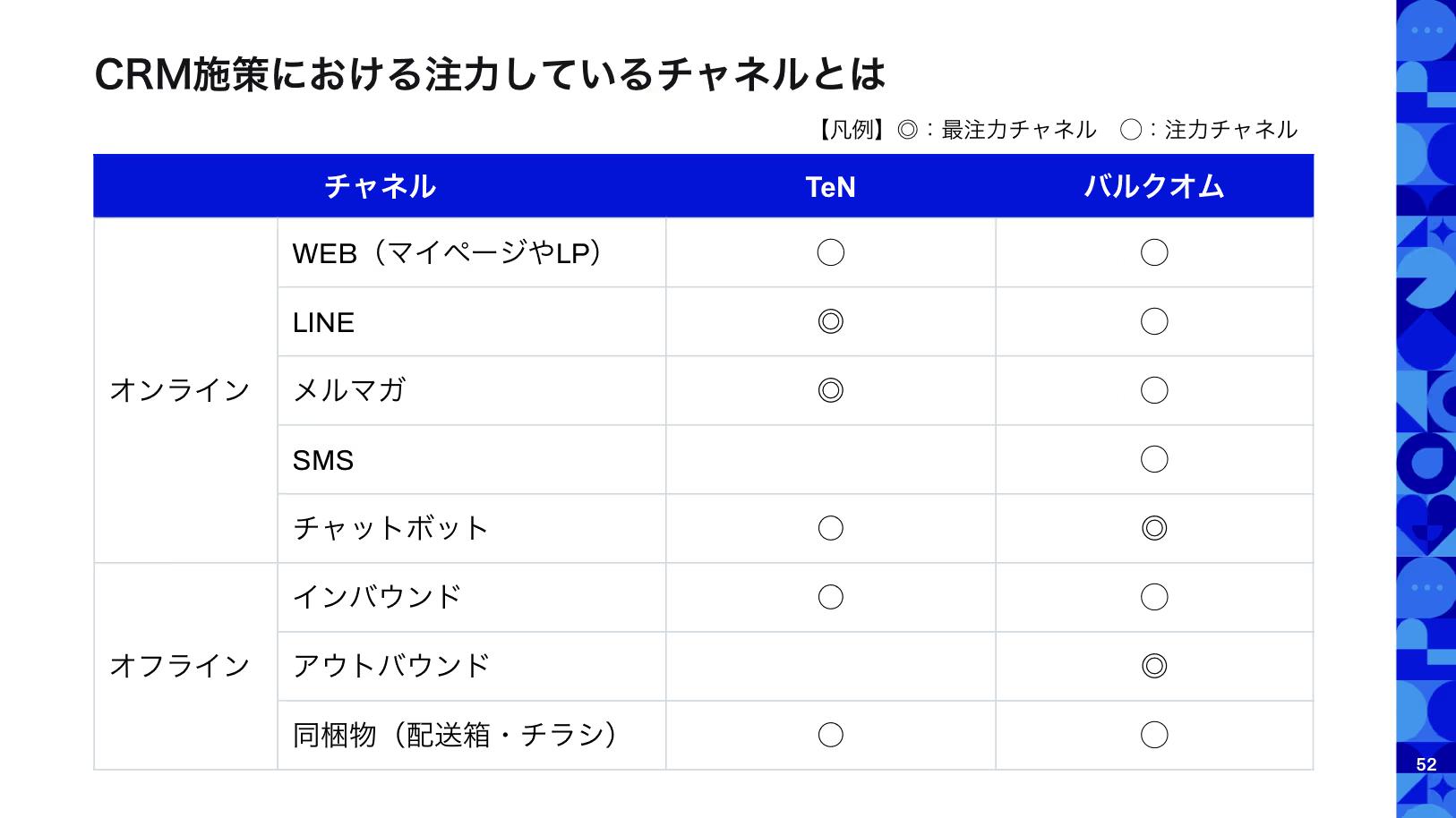
Online, we’re talking about channels such as LINE, email newsletters, SMS, and chatbots; offline, this would include inbound and outbound calls, package inserts, and so on.
Could we first ask Mr. Ikeda to speak about some of the actual initiatives involving chatbots and outbound activities?
TeN, Mr. Hideki Ikeda (hereafter, Ikeda):
Yes, that’s right.
At our company, we are currently focusing mainly on LINE, email, and package inserts. Our business is run by a team of five, and from the standpoint of selection and concentration, we have chosen these channels. With limited headcount, we need an efficient and focused approach.
I have previously been involved in cosmetics e-commerce, so I can make a good comparison, but the “food and beverage” business we are currently developing has a very different retention profile. We have a large number of high-quality customers; to give a concrete figure, our F2 conversion rate is around 85%.
My view is that, whereas cosmetics tend to be chosen for their functional benefits, food products make it easier to manage customer expectations in terms of “tastes good / doesn’t taste good,” and so on.
On the other hand, the average order value is lower, and it takes considerable communication effort to make our products part of customers’ daily routines, so our main initiatives focus on raising average order value through measures such as cross-selling.
When making proposals in this area, we are particularly strong at conveying emotional value through text, so channels like LINE and email are the easiest for us to use for communication, including in terms of open and response rates.
Given the organizational setup I mentioned at the beginning, it is only natural that we have ended up concentrating our efforts on LINE and email.
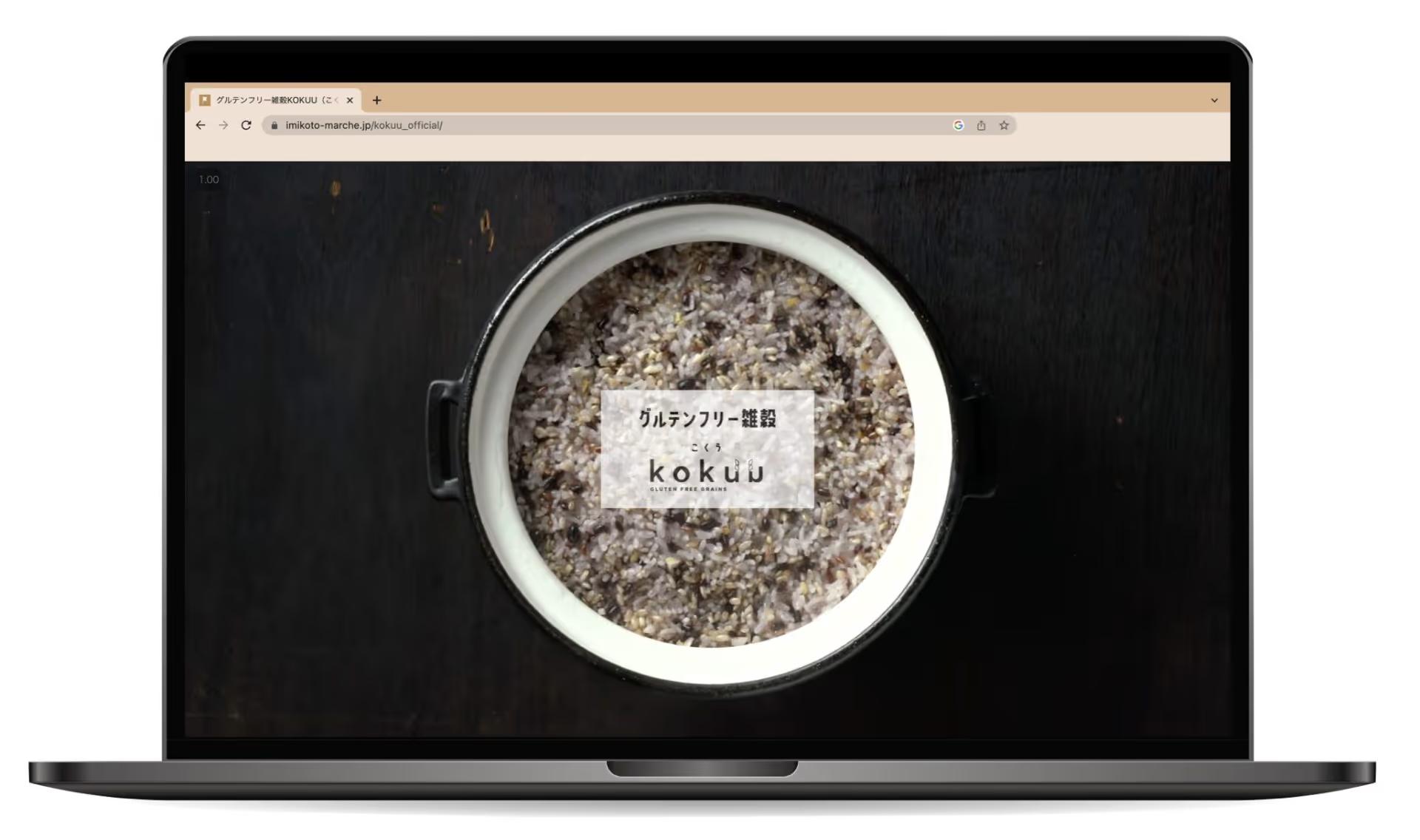
Gluten-Free Mixed Grains “kokuu” Official Page https://imikoto-marche.jp/kokuu_official/
A.Morimoto:
Thank you very much.
The way we communicate will change not only depending on the organizational setup, but also on the characteristics of the underlying products, correct? What are your thoughts on this, Mr. Morimoto?
BULK HOMME Mr. Kanta Morimoto (hereafter, Mr. K.Morimoto):
Yes. Building on what Mr. Ikeda just shared, I would like to explain from two perspectives why we are focusing on outbound.
I will break it down into two points: the characteristics of the products BULK HOMME handles, and the characteristics of the channels.
Regarding the product characteristics, because we mainly deal in men’s cosmetics, many customers feel the products are difficult to use, or are trying items like emulsion for the first time. As a result, there tends to be a large volume of information we need to convey to customers. To be frank, relying solely on text-based communication such as flyers or email newsletters has its limits. That is precisely why we use outbound, which allows us to customize our approach for each customer and communicate our message more effectively.
Another advantage is that the optimized messaging we develop through outbound can be applied to other channels such as chatbots and landing pages, creating strong synergies.
Next, from the channel perspective, outbound has the characteristic that simply refining the script or changing the calling method can easily generate immediate results. As Mr. Ikeda mentioned, channels like email newsletters and LINE require steady, medium- to long-term optimization, so there is also a difference in how long it takes for measures to show results.

BULK HOMME https://bulk.co.jp/
A.Morimoto:
I see. That was quite unexpected for me.
So it’s not outbound activities like upselling or cross-selling, correct?
Mr. K.Morimoto:
That’s right. When people hear “outbound,” I think many of them strongly associate it with hard‑selling and aggressive acquisition, but what we are doing now also includes outbound calls where we simply phone customers before we send them their second product and just ask, “Do you have any concerns right now?” Because we only ask about their concerns, the talk script is so short that we could practically publish it as is.
We are currently focusing on this type of outbound as well, where the content of the conversation is entirely oriented toward the customer experience of solving customer issues, based on each customer’s specific concerns.
A.Morimoto:
That’s also quite a distinctive point, isn’t it?
When you think in terms of LTV, many companies inevitably focus on trying to drive cross-sell and upsell.
What do you think about BULK HOMME’s approach, Ikeda?
Mr. Ikeda:
To be honest, the moment I heard about this in rehearsal, I immediately thought, “We should do this right away.” (laughs)
We had also been considering that idea under the name “Thanks Call,” but as a result of the prioritization and focus we discussed earlier, we decided not to move forward with it.
Also, I forgot to mention this a moment ago, but there is one more reason we are using LINE and our email newsletter: while our company is strong in text, we believe that the most effective way to convey “deliciousness” is ultimately through visuals.
Once visual elements are involved, channels that can appeal visually become extremely important and highly effective. It’s very much a case of “seeing is believing.”
Given that background, we decided to first concentrate our efforts on media that can make a strong visual impact.
A.Morimoto:
I see. Thank you very much.
In the CRM field, there are various KPIs such as retention rate, response rate, and churn prevention rate. Regarding your internal CRM initiatives, I’d like to know which specific indicators are considered particularly important. What are your thoughts on this, Mr. Morimoto?
Mr. K.Morimoto:
In our company’s case, for example, we break down sales into multiple factors and take those into account.
In addition to the number of members, we factor in the duration of membership, the number of shipments per month, the average purchase unit price, and the return rate. We also consider situations where orders are actually canceled or changed, and we perform factor analysis by combining multiple indicators.
A.Morimoto:
In the case of BULK HOMME, I get the impression that each section is specialized and pursuing its own KPIs. Does that mean that all of you are actually working toward the same set of indicators?
Mr. K.Morimoto:
No, we are approaching this from a comprehensive perspective rather than focusing on just a single factor.
For example, we do not have separate specialists who exclusively analyze cancellation rates, or specialists dedicated solely to optimizing retention rates, or specialists focused only on increasing the average unit price. Instead, we assume that improving one element may also have an impact on other elements.
A.Morimoto:
I see, so you’re saying that while sharing the same goal, you’re working together and coordinating as an organization.
By the way, in your case, Ikeda, I’m curious how you set KPIs when organizational resources are limited.
Mr. Ikeda:
Since BULK HOMME’s answer was really like a textbook example, I was wondering if there was even anything left for me to say. (laughs)
When it comes to doing CRM, we pay close attention to “retention rate,” which has a large business impact, and in particular we look quite closely at the more granular area around F2 to F3.
Also, we have one or two meetings a month that include members of our customer support team, and at those times we share qualitative, positive feedback—such as whether the number of positive comments we receive from customers has increased. It feels like we are deliberately creating a day to confirm with each other, “I’m glad we’re running this business.” Of course, it is also important to stay focused on the quantitative side.
Mr. K.Morimoto:
As you say, the unfiltered voices of our customers are extremely important. Once a month we compile customer feedback and share it internally.
A.Morimoto:
As expected, the determination not to miss what users are saying is something all brands have in common.
Mr. Ikeda:
I was just talking with Mr. Morimoto about this as well, but in the end, from a business operations standpoint, we obviously have to generate solid sales and profit. Personally, I think if you pour money into advertising, sales will go up. That said, profit ultimately will not increase unless the value you provide is properly aligned.
In my experience, simply taking know-how that works well at other companies and sliding it over horizontally into our own business usually does not go very well. So before trying to copy anything, the most important thing is to go and find out what our own customers actually want.
It is crucial to ground that understanding in facts, so I make sure to secure a certain amount of time to really face that task.
A.Morimoto:
User feedback is extremely important.
In your CRM activities, do you have any initiatives that you can say, “This really worked!” and would be worth sharing with everyone?
Mr. Ikeda:
Right. I actually watched the previous session as well, and we’re also running initiatives that acquire users via Instagrammers.
In terms of the channel, there was some discussion that while we can acquire a lot of users, their retention tends to be low, and in fact when we first started we fell into exactly that situation. There was a period when we were unsure whether we should continue with the initiative.
As we worked on improvements and listened to customer feedback, we started to see comments here and there saying they had bought “on a whim.”
The reason, we realized, was that with our traditional push-type ads, the article comes right before the LP, so on the LP side we had been focused on how to optimize the purchase flow. However, with traffic coming via influencers, the majority of users land directly on the landing page, so we changed the flow so that, in practical terms, people could properly understand that landing page.
At first glance, this might sound like just a story about LPO in a new acquisition channel, but in the end, while CVR dipped slightly, retention actually recovered to about the same level as before.
Those customer comments I mentioned earlier—like “I didn’t really look at the LP properly”—also decreased. Rather than doing so‑called CRM only after acquisition to try to realign expectations, I believe it is crucial to control expectations properly before customers come in.
A.Morimoto:
Thank you. Controlling the entry point is very important, isn’t it? If the initial expectations are misaligned, it can easily become a trigger for cancellation.
What are your thoughts, Mr. Morimoto?
Mr. K.Morimoto:
As Mr. Ikeda said, I believe controlling the entry point is important not only for the customer experience, but also in terms of the numbers.
To give a concrete example, the outbound initiatives we ran before F2 conversion, which I mentioned earlier, have shown results in the retention rate as well. The retention rate from F3 onward is significantly different for customers with whom we were actually able to connect and who listened to us properly.
I believe that conversations that are not solely focused on sales, as suggested in the session title, can build customer trust, and this changes the medium- to long-term compounding effect.
This goes back to what we were discussing earlier, but the straightforward effort that Mr. Ikeda mentioned—capturing the customer’s voice based on facts and properly translating it into content—is proving successful.
Theme 2: Channels to prioritize going forward
A.Morimoto:
As both of you mentioned earlier, I would appreciate it if you could elaborate on the areas you would like to focus on going forward and why you intend to prioritize them. What are your thoughts?
Mr. K.Morimoto:
Going forward, I want us to deliberately improve both the quality and the volume of our touchpoints with customers.
In practical terms, when we say “improve quality,” we mean refining the content of our LINE and email newsletters. To be frank, this is not something that will explode in the short term, and there is no silver bullet, so it is an area where we simply have to keep working steadily.
In terms of “volume of touchpoints,” it comes down to channel mix. Until now, each channel has operated independently, so we are now exploring what happens when we combine, for example, email newsletters with outbound calls, or SMS with LINE and email, or outbound with inbound. By combining the different channels, we want to generate synergy, and this is exactly what we are currently working on.
A.Morimoto:
This is something I was personally very curious about and wanted to ask you. For example, if you were to combine LINE with email newsletters or something similar, could you tell us, to the extent you are able, what kind of channel mix you are currently using in concrete terms?
Mr. K.Morimoto:
Let me see. For example, initiatives where we combine SMS and outbound calls, sending an SMS before making the call and then following up with an outbound call.
We also have initiatives where, in addition to email, we contact customers who have experienced issues such as payment errors via SMS and outbound calls as well.
A.Morimoto:
I see.
We also run SMS initiatives with “BOTCHAN,” and there are users who go as far as entering their phone number in the chatbot but then drop off.
When we send SMS messages to those users, the response rate is very high, and we can acquire them at a very low CPO, so this approach is working extremely well right now.
At first I assumed people hardly look at SMS these days, but in reality they do check them quite a lot, don’t they?
Mr. K.Morimoto:
That’s right. The majority of our customers are basically men, so many of them always have their mobile phones with them. In that sense, I believe there is relatively strong compatibility with that channel.
A.Morimoto:
That’s extremely helpful. What are your thoughts, Ikeda?
Mr. Ikeda:
That’s right.
Up until just now I kept talking about “selection and concentration,” but we’re getting to the point where what we want to do is starting to pile up so much that it no longer fits under that label. (laughs)
There are quite a few things I want to focus on or tackle going forward, and I’d like to continue digging deeper into LINE. We’re steadily pushing ahead with things like LINE ID integration, and I feel we’re getting close to a point where “there’s almost nothing you can’t do with LINE.”
Also, it’s very much a trend right now, but I believe the combination with ChatGPT still has a lot of untapped potential. Until now, it has always felt like a trade-off between efficiency and quality, as if you had to choose one or the other. I see this as one of the triggers that could actually deliver both high efficiency and high quality at the same time.
I think there are still very few concrete examples in this area, but we would like to take on the challenge and create case studies within our company.
The second point concerns the enclosure materials, and this is an area where we would like to move things online.
Right now it is quite difficult to accumulate data for running the PDCA cycle, so we would like to digitize this area in order to visualize that data.
Also, the products we propose as cross-sell items are often seasonal, so product turnover is extremely fast. Some items are gone in as little as two weeks, so while we want to adjust accordingly and deliver accurate information, that is quite difficult to do with offline media.
There is also the straightforward aspect of cost reduction, and moving online broadens the range of possible initiatives.
I mentioned earlier that focusing on visuals leads to better results, and we have come to understand that video is more effective in this area.
It may no longer feel like a "printed insert" at that point, but one of our aims is to clearly separate what we keep as a physical enclosure from what we deliver as information online rather than in physical form, and move forward on that basis.
I’d also like to further promote the idea of turning our brand into a community.
To put it in a single phrase, what we’re aiming for is a “self‑driven brand.”
Of course, we as a company have our own vision for what we want the brand to be, but we don’t see it as something we create on our own. We want to build it out by incorporating the voices and feelings of our users.
If the only connection between us and our customers is through the product, then “the quality of the product = the relationship with the corporate brand.” But if there are other customers walking alongside them, and we can create a place where horizontal connections form, then I believe we can create reasons to stay engaged with the brand that go beyond just whether the product is good or bad.
We want to take on the challenge of incorporating this idea of a community as one of the concepts that shape our brand.
A.Morimoto:
A self-propelled brand!
There are aspects that are possible precisely because TeN is working in the field of “food,” aren’t there? Recipes alone, for example, exist in countless variations, as many as there are users, and I really feel there’s enormous room for expansion.
Ikeda:
When we look at UGC, we often see content that makes us think, “You can make something like that with our products!?” It’s incredibly gratifying. Some people even take the time to list the recipe ingredients in detail, so we actually try making them ourselves. They’re incredibly delicious.
Theme 3: A message to our viewers
A.Morimoto:
We’ve talked extensively about the CRM domain up to this point.
Among those watching today, there are many manufacturers as well as many support/consulting firms. I’d like to close this session by asking each of you to share a final message for those who are planning to focus more on CRM going forward.
Mr. K.Morimoto:
Yes.
First of all, thank you very much for listening up to this point.
To close, this may sound a bit presumptuous, but if I may add one more point: from my personal, hands-on perspective, there is no such thing as a magic bullet when it comes to CRM initiatives. Up until last year or the year before, we were relentlessly focused on development while constantly asking ourselves what services would truly deliver value to our customers. Only from the latter half of last year into this year have we finally reached the stage of figuring out how best to deliver those services. That is roughly where we are now. I believe we are moving into an environment where we can offer services that are even more refined, so please look forward to what is coming next.
Mr. Ikeda:
Thank you very much for listening to me all the way through.
When I think about running a brand with this kind of e‑commerce business model, I have always felt that CRM in particular cannot be driven by technique alone.
As I mentioned earlier, we first need to firmly grasp, based on facts, “what customers are expecting,” then clearly define our objectives in terms of what we should do, and only then bring in the most suitable know‑how and initiatives. I believe that is the right approach.
Personally, I follow many excellent senior professionals on Twitter and elsewhere, and I have learned a great deal from what they share and actually adopted many of their ideas.
One thing I can say with confidence is that, in the end, the professionals who know a brand best are the people in charge who also see what is happening on the ground. While maintaining that sense of responsibility, I would like those people to define their goals and objectives, and then customize and implement the various know‑how and tactics that others are sharing.
Our own main business is advertising agency work, and above all we value our clients.
Thanks to that, there is a great deal of mutual information flow between us.
Including that aspect and the horizontal connections among companies in the same industry, I think the ideal would be to improve the flow of information so that we can all share what works well and, conversely, collectively avoid what does not.
A.Morimoto:
Thank you very much.
We’ve received various tips from both of you, but as you mentioned earlier, there isn’t a single “just do this and you’re all set” kind of solution.
In the end, what really matters is how closely we can stand by our users – a sort of spirit of hospitality. I believe that way of thinking is something everyone here can commonly refer to and apply.
Thank you both very much for today.
If you would like to confirm whether BOTCHAN can be implemented in your company, or if you would like advice tailored to your situation, please feel free to contact us with your questions or inquiries.
A specialist consultant will respond.