
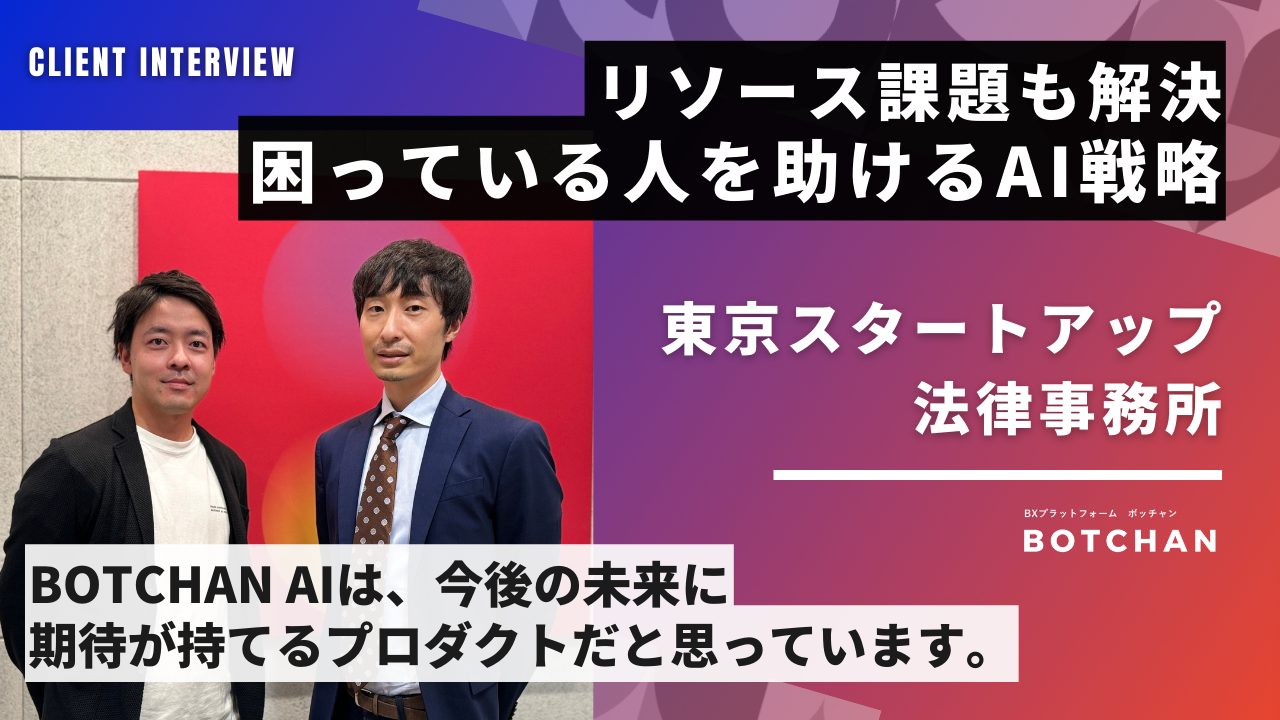
We are pleased to introduce the latest case study of “BOTCHAN AI,” which is helping to shape the future of Tokyo Startup Law Office. In this article, we unpack how Managing Partner Attorney Mr. Nakagawa decided to implement AI, lowered the barriers to legal consultation, and ultimately linked these efforts to incoming inquiries. As we explore the unknown potential and pathways to success, we examine how the warm, human-like communication provided by AI is becoming a key factor in building trust with clients and driving transformation in the legal industry.
BOTCHAN AI Business Director, Tomoki Morikawa (hereafter, “—”)
To begin, could you briefly introduce yourself, Dr. Nakagawa, and tell us about your business activities?
Mr. Hirohide Nakagawa, Managing Partner, Tokyo Startup Law Office (hereinafter, “Mr. Nakagawa”)
Yes. I run a law firm called Tokyo Startup Law Office. It has been about five years since we opened, and we are a full-service firm handling both individual and corporate clients.
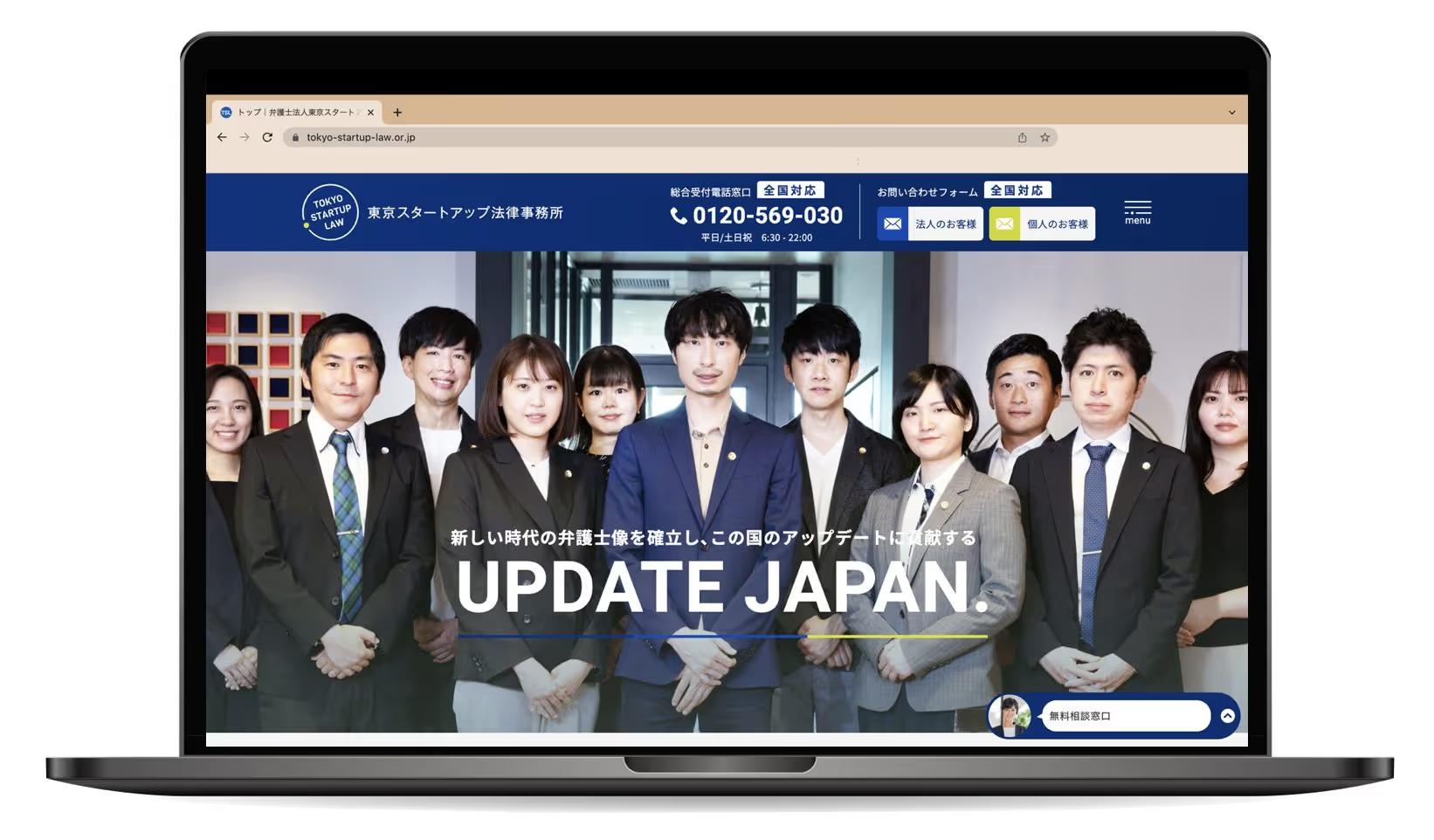
Official website: https://tokyo-startup-law.or.jp/
After passing the bar exam, I joined a small law firm, and later served as a branch manager at a major law firm. There was actually a period when I temporarily took a break from legal practice, during which I even took a professional basketball tryout. (At the time, I heard the acceptance rate for foreign players was about 1 in 200.)
After that, I took on various challenges, such as developing an app similar to a local social network and traveling more than 200 days a year, before establishing my current firm.
I have also appeared as one of the “tigers” on the Reiwa no Tora channel.
— You really took on a wide range of challenges, didn’t you?
Among all of that, “law firm × chatbot” seems like a rather unfamiliar combination. What kinds of issues or challenges were you facing at the time that led you to consider it?
Mr. Nakagawa
As expected, our challenge was the CVR.
I had long been thinking about how to further increase the probability that visitors to the site would make an inquiry.
Given the nature of a law firm, I initially wanted to operate it as a live chat. Something like having operators on standby in the background so that consultations are available 24 hours a day.
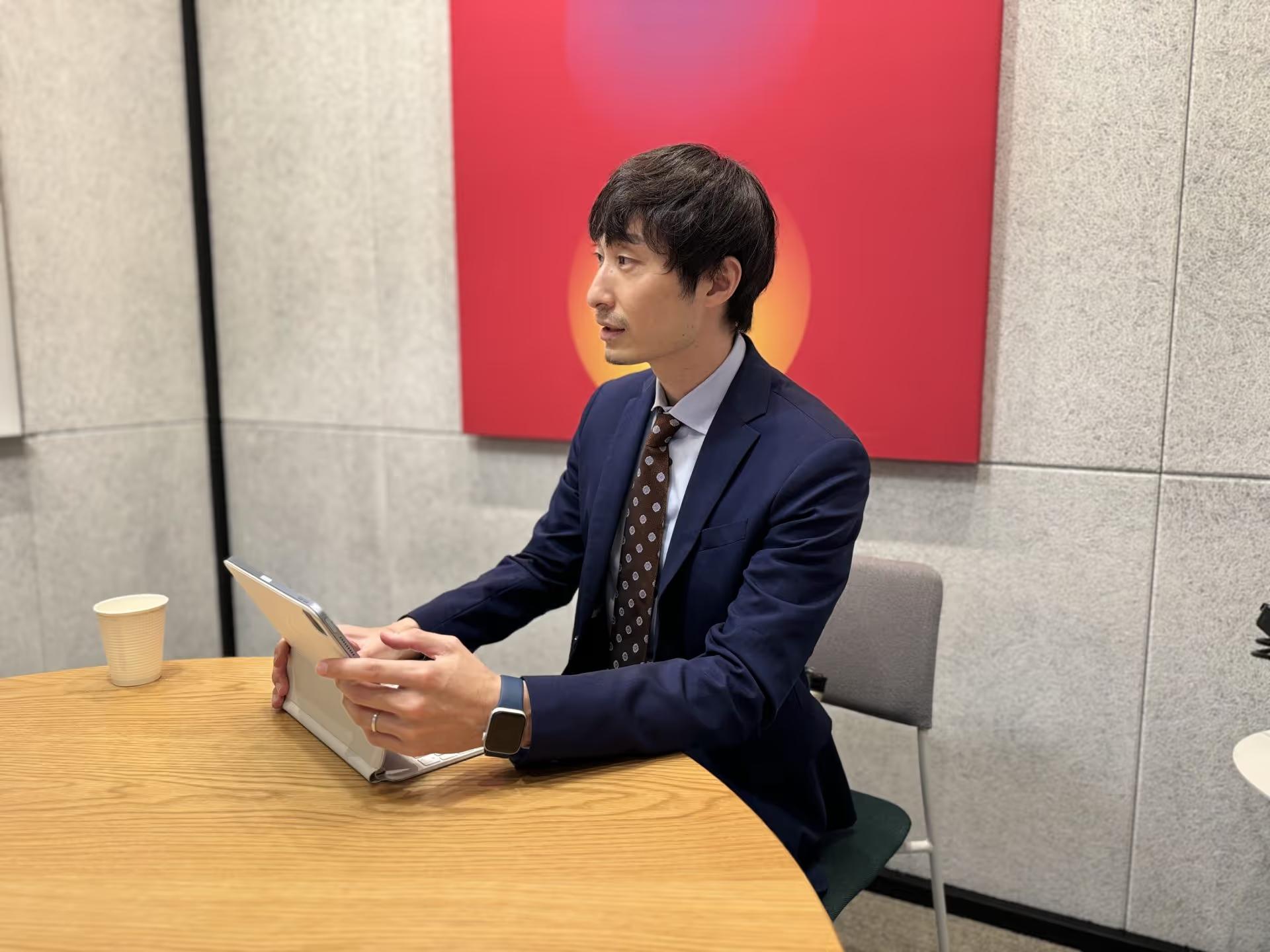
We had actually been considering doing this, but it would obviously require significant cost and resources, so we were proceeding cautiously. At the same time, when we put ourselves back in the inquirer’s shoes, we started to form a hypothesis that a more systematized response might actually be better for them.
It was right around the time we were having those discussions that Speee told us, “We have something like this,” and introduced BOTCHAN AI. We decided to implement it, thinking it would be ideal if AI could handle this for us.
— I see. Given the characteristics of the industry, it is important, in addressing the challenge of improving CVR, to give users a sense of reassurance that “a real person will respond and they will receive an immediate reply.”
Mr. Nakagawa
That’s right. The people consulting us reach out while feeling anxious, so I felt that responding immediately and helping them move even a little closer to a solution would be an important source of reassurance.
In fact, if we could really have someone on standby in the background and provide a response from our side the moment an inquiry is sent, that kind of customer experience would be quite good, I think. However, as I mentioned earlier, the issue of human resources arises, and we also have to consider the cost of training people on how to respond.
I did think about trying to handle it myself once, but I am not good at staying up late, so I realized it would be difficult after all. (laughs)
— Thank you very much.
In that context, could you tell us about the background that led you to decide to implement our product?
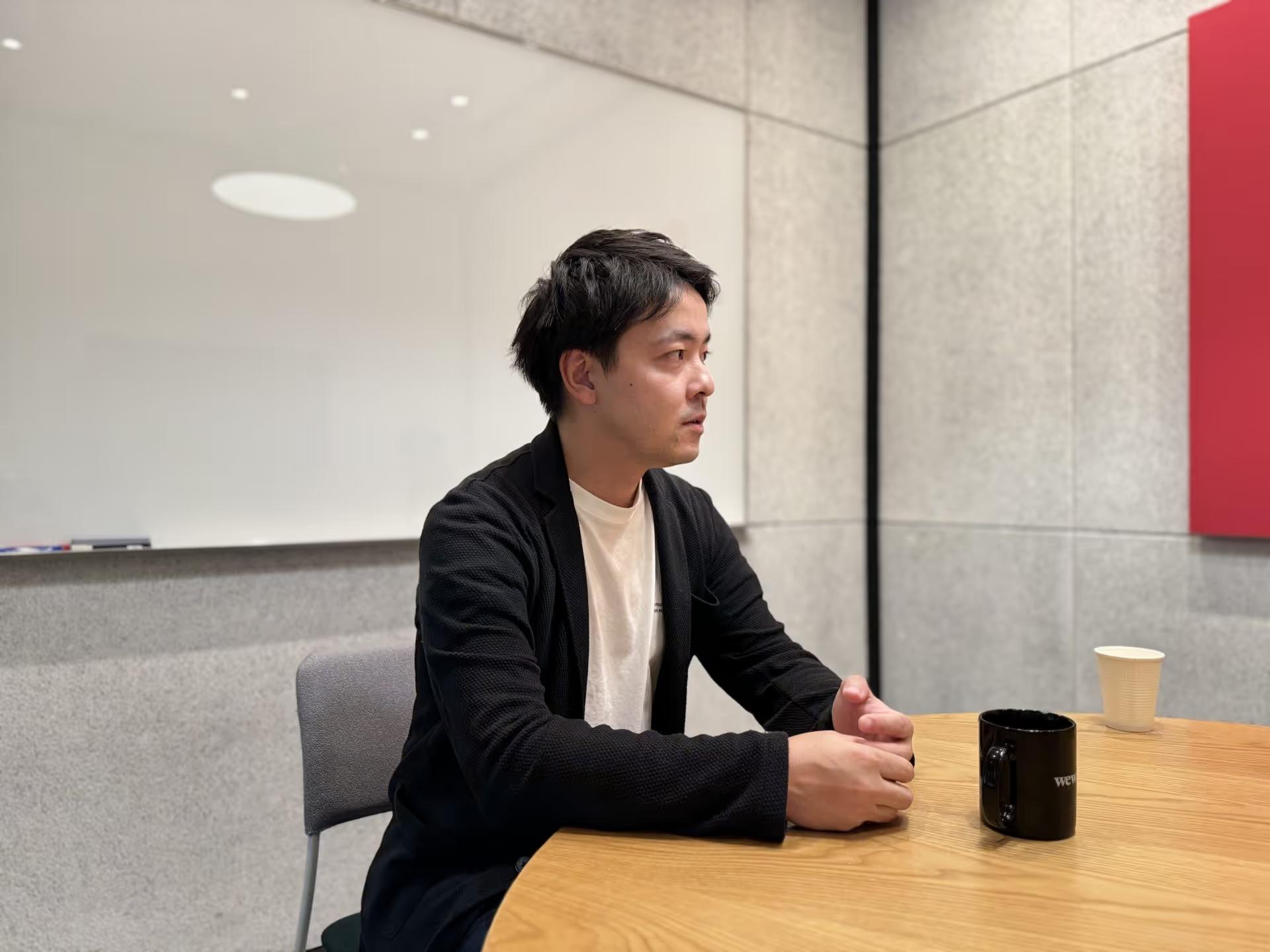
Mr. Nakagawa
Yes.
To begin with, I was quite skeptical about how reliably AI could actually respond. However, the timing of your proposal coincided with the period when ChatGPT was starting to gain wider recognition in society, and I was personally very impressed by the capabilities of AI. That was a major deciding factor for me. So I felt that if we could combine ChatGPT with a solution that evolves into an AI dedicated to our company, it would have very significant potential.
I also felt that, in terms of support, wevnal seemed likely to work closely with us and stay aligned with our goals.
— Thank you very much. As you moved toward going live in production, were there any aspects you felt were hurdles or challenges?
Mr. Nakagawa
As expected, since this is a legal matter, it is rather difficult to give a clear answer.
Asking something like, “What’s the weather today?” and asking, “I’m struggling with this situation right now—what solutions are there?” are completely different types of questions, right?
Also, since we are running this as a measure to ultimately lead users to make an inquiry, it was quite challenging to figure out how to guide them that far—how to lower the hurdles and perceived barriers for customers.
— Right, exactly. Of course it’s important that the chat can provide an appropriate answer to begin with, but it’s not just about solving the issue—it’s also crucial to guide the user all the way through to making an inquiry.
Mr. Nakagawa
Yes. But I do think there are actually many people who just want to get information.
Even on media where lawyers solve people’s problems, about 99% of users are only there to obtain information.
To some extent, that cannot be helped, but even so, there are people whose issues are serious enough that they really should be making an inquiry, and they are dropping off instead. I want to resolve that situation.
— First, in terms of providing appropriate answers, we broke down the risk of so‑called hallucinations—statements that are not based on facts—into about seven risk categories and conducted rigorous, repeated testing.
From both companies’ perspectives, we carried out pre‑testing and refined it to the point where we agreed the behavior was within an acceptable range, and then decided to move ahead to the live deployment in a trial‑and‑error manner.
After it was actually introduced, what kind of response did you see?
Mr. Nakagawa
As expected, since a lot of effort had gone into crafting the responses, most of them felt quite natural.
What I do find difficult, however, is the part about “leading it to an inquiry.” There’s no precedent for that, after all.
— I see.
As I went through the tests from an ordinary person’s perspective, there was a lot that I myself learned along the way.
To give one example, even in the case of divorce, the process differs depending on whether or not there is supporting evidence.
There were cases where the answer was that, if your decision is firm and you have evidence, it is better to consult a lawyer. On the other hand, there were also answers suggesting that it might be worth pausing first and reconsidering the marital relationship.
Mr. Nakagawa
Right. What I really wanted to do was to “stay as close as possible to every customer inquiry.”
We also have inside sales staff at our company, and what I constantly and emphatically tell the team is this: “Do not respond in a mechanical, script-like way. It’s understandable if you can’t answer the highly specialized questions. But no matter what, make sure you stay close to how the other person is feeling.”
— It’s that human warmth aspect, isn’t it?
For this project, we have been very particular about how we created the training data for Tokyo Startup Law Office.
We divided communication quality into three levels. First, as Level 1 foundational work, we trained the model on content generally referred to as “knowledge information,” such as the information published on official websites.
At Level 2, we trained it on so‑called “knowledge base information,” including internal workflows and manuals.
Finally, although there were still relatively few use cases, we obtained conversation and audio data in which our inside sales staff, such as Mr. Nakagawa, engage in the kind of empathetic communication they value. We transcribed this data and had GPT‑4 perform rewriting and summarization, then imported it as training data.
Because we carried out this kind of groundwork, the system can now produce a variety of patterns for back‑channel responses and similar expressions.
For example, when it receives a consultation such as, “My grandfather has passed away and I would like to proceed with inheritance procedures,” it can respond with something like, “Please accept my deepest condolences.”
We are continually refining the service so that, like a human, it maintains a warm tone from beginning to end while it learns day by day.
Mr. Nakagawa
Thank you very much.
As I mentioned briefly earlier, I believe the key to getting people to consult a law firm is to “lower the barrier as much as possible.”
In that respect, I feel that an AI chat system is most meaningful when it serves as a kind of bridge.
When I actually speak with clients, many of them say things like, “Is it really okay to take up a lawyer’s time with something like this?” In fact, it is precisely with those kinds of issues that I want them to come and consult us… that’s how I feel.
— I see.
We ran a test on banner copy for opening an AI chat, using
① “Get free advice” and ② “Try asking the AI for advice.”

— As a result, option ②, “Try consulting AI,” had roughly double the click-through rate, didn’t it? I believe the hurdle that Dr. Nakagawa mentioned is clearly reflected in this outcome.
Apart from that, what was the biggest change before and after implementing “BOTCHAN AI”?
Mr. Nakagawa
In terms of numbers, we have seen a dramatic increase in inquiries by email.
Our flow is that, after we handle an initial consultation via the AI chat, users are directed to a form and then submit an inquiry to the firm. Inquiries coming through that route have increased by a factor of 7.6. This has also led to more conversions.
Originally, we had a high volume of inquiries by phone. Many people call in a panic when they are really in trouble.
— 7.6 times!
With phone calls, it also consumes personnel resources and incurs costs on the office side, doesn’t it?
Mr. Nakagawa
Yes, that’s right.
Also, when we receive inquiries by email, many people clearly organize and describe what they want to discuss and what they are struggling with, so the subsequent communication proceeds very smoothly. For both parties, being able to resolve matters smoothly is a very positive outcome, isn’t it?
▼ “Tokyo Startup Law Office” Demo Bot Video
— Yes, exactly.
I’m very pleased that it ultimately led to more conversions, but there’s one aspect that I personally find particularly interesting.
When you implement it on a website, it naturally creates a conversation right before a conversion happens. Even if it does not result in a conversion, I find it very compelling that we can now hear the real voices of people who would previously have been invisible—so‑called silent users.
Mr. Nakagawa
Right. We can also drill down into what they are struggling with and why it did not lead to a conversion, and then consider possible improvements.
— Yes. Since we have been able to incorporate new information into our learning and adjust the creatives while running the PDCA cycle, we are also pleased to see that we are making steady progress, even if only step by step.
Finally, I’d like to ask: what does “BOTCHAN AI” represent to you, Professor Nakagawa?
Mr. Nakagawa
First of all, I feel like this product will actually allow me to do the things I’ve been wanting to do, and it makes me optimistic about the future.
To speak seriously, there are countless people in the world struggling with legal issues, and among them I believe there are many who are truly in trouble, really should be consulting a lawyer, but aren’t—and as a result, they end up at a disadvantage.
I suspect that even those people at least had the word “lawyer” come to mind.
But there is still some kind of barrier there, and they never quite feel able to take the step of seeking advice. If we can help those people, I believe our market will grow by far more than just double.
What is needed to lower that barrier is, after all, to use AI to reduce the threshold for accessing lawyers, so that people feel, “It’s okay for someone like me to seek advice.” That benefits both our customers and us, so I hope we can move in that direction, and I see this as a product that gives us real reason to expect that to happen.
— Thank you very much for your kind words.
I hope we can move toward a world where even a few more people can be saved.
Mr. Nakagawa
That’s right. For example, if we take the issue of child support after divorce, in reality only about 20% of the child support that should be paid until the child reaches adulthood is actually collected. If, at the time of divorce, you properly engage a professional, have everything set out in a notarial deed, and accurately confirm details such as the employer’s name, then when it comes down to it you can recover the payments through compulsory execution. You can even do things like garnishing wages, so the living conditions of single mothers should definitely improve.
— I see. So that’s something you can do.
I agree with Dr. Nakagawa’s view of wanting to pick up the unheard voices and broaden the scope of support for those who are vulnerable.
Lastly, we would appreciate a brief message that could encourage companies who are still unsure about implementing “BOTCHAN AI.”
Mr./Ms. Nakagawa
Not only at law firms but also at clinics and similar places, there are far more people than you might think who feel a psychological barrier to seeking advice.
Many people hesitate, wondering whether it is really worth taking up someone’s time with a question like this, but in reality everyone is struggling with something.
Precisely those people are the ones who should originally become customers, so I think it would be good to at least try introducing this as a way to lower that barrier.
— Thank you very much.
Thank you very much for taking the time to share so much with me today.
I look forward to your continued support.
If you would like to confirm whether you can implement BOTCHAN in your own company, or if you would like advice tailored to your situation, please feel free to contact us with your questions or inquiries.
A specialist consultant will respond.